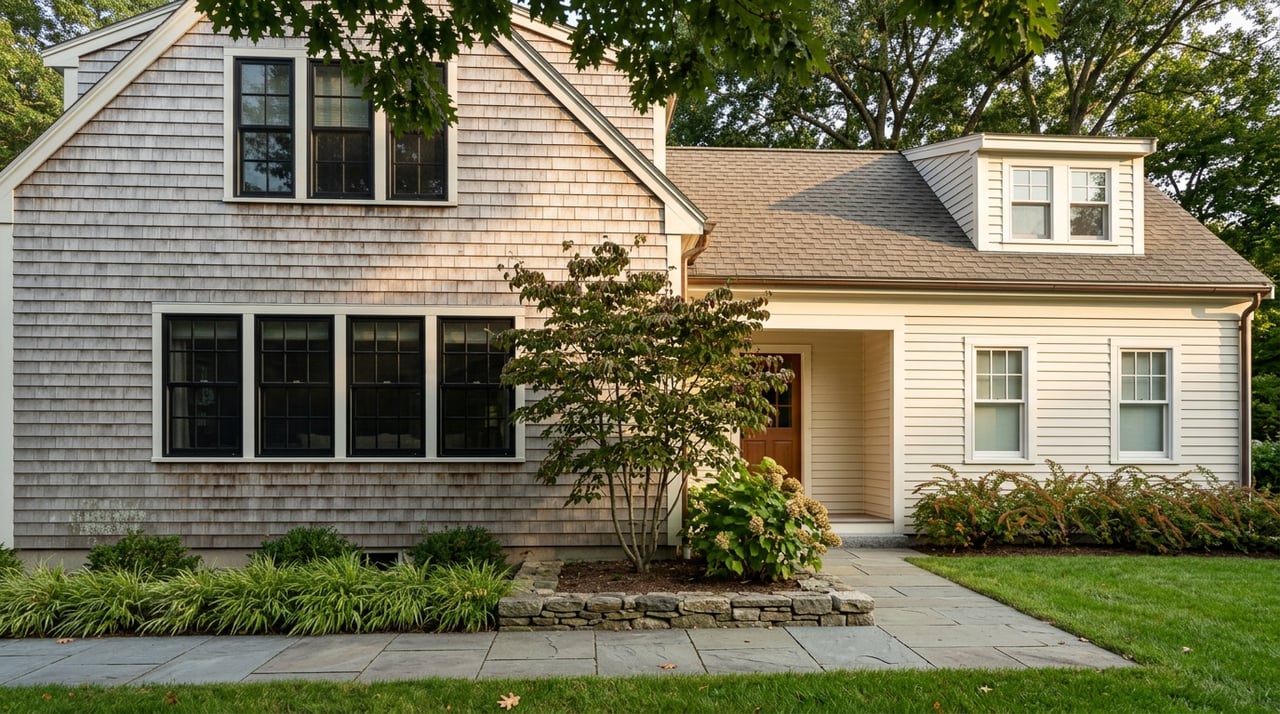
Newton Rezoned for 8,330 New Homes. So Far, 34 Exist.
August 20, 2026
August 20, 2026
If you are shopping in Newton and someone mentions the city's new zoning, they are usually talking about a number: 8,330. That is how many multifamily units Newton was required to zone capacity for under the state's MBTA Communities Law. It sounds like a wave of new housing is about to hit the market.
Here is the number that actually matters if you are buying, selling, or sizing up a renovation candidate in Newton right now: 34. That is how many net-new homes had actually reached permitting, construction, or occupancy under the city's new zoning as of the City Council's own progress check in February 2026. The gap between those two figures is not a rounding error. It is the whole story, and it changes what you should actually check before you make an offer or list a property.
Newton's City Council passed the Village Center Overlay District, or VCOD, on December 4, 2023, to comply with the MBTA Communities Law. The zoning applies near seven village centers and transit stations: Newton Centre, Newton Highlands, Eliot, Waban, Auburndale, West Newton, and Newtonville. It layers three categories on top of existing zoning. Village Center 3 (VC3) allows the tallest, densest buildings in commercial cores. Village Center 2 (VC2) allows more modest development on smaller Main Streets. Multi-Residence Transit (MRT) covers the residential streets at the edges of those centers, where the goal is smaller-scale change: fourplexes allowed by right, with even more units permitted when the existing house on the lot is preserved rather than torn down.
The 8,330 figure is a capacity requirement, not a construction forecast. The law tells Newton how much zoned potential it has to create. It does not require a single owner to build anything.
That distinction matters because the overlay is opt-in. A property inside the VCOD keeps its old zoning as an option alongside the new one, so an owner who never wants to add units simply doesn't. Citywide data on properties already zoned for two-family use makes the same point from a different angle: on lots where current rules already allow a second unit, 40 percent still have just a single-family house sitting on them. Having the right to build density and choosing to use it are two separate decisions, and most owners are choosing not to.
That is exactly what has played out under the new overlay. As of the Zoning and Planning Committee's twice-yearly review this past February, eight MRT adaptive-reuse projects had reached permitting, construction, or occupancy. Together they represent 49 homes, 34 of them net-new. The MRT districts themselves cover less than 2 percent of Newton's land area. Set against a citywide housing stock of roughly 33,000 units, 34 additional homes is a real but genuinely small change, not the transformation the headline number implies.
The 34 homes are not spread evenly across Newton. A local newsletter tracking the rollout in 2026 identified at least five MRT projects concentrated in Newton Highlands and Newton Centre, largely along the Centre Street corridor that connects the two villages. That corridor exists on the zoning map partly because it had to: planners needed a contiguous stretch of land long enough to satisfy the state's acreage rules, and Centre Street was the connective tissue available.
Newtonville, by contrast, has seen activity at the denser Village Center tier rather than in MRT. Two projects are moving there: one preserves a historic church by converting it to residential use while adding a new building on the same lot, and the other is a fully deed-restricted affordable building that qualified for an extra story specifically because of that affordability commitment.
Waban sits at the opposite end of the intensity scale. Its overlay uses only the lowest two categories, VC2 and MRT, and accounts for roughly 5 percent of the citywide unit allocation. Some villages were left out of the overlay altogether, each for a different structural reason. Nonantum was excluded because it already has more three-family homes than any other part of Newton, so the missing-middle housing the law is designed to encourage already exists there. Auburndale couldn't meet the minimum contiguous-acreage requirement once priority commercial streets and public land were subtracted from the map. Chestnut Hill is largely boxed in by its historic district, institutional land that can't be rezoned, and a street already zoned for development under separate rules.
If you are comparing villages on the assumption that the same zoning story applies everywhere in Newton, it doesn't. The map, not the citywide total, tells you what is actually possible on a given block.
Here is the detail that best captures how modest this zoning actually is in practice. When city planners needed real-world examples to explain building size limits under the new rules, they pointed to the Trio apartment complex in Newtonville and a four-story mixed-use development on Austin Street, both built under the old special-permit process. Neither one fits within the VCOD's new by-right limits. If either were proposed today, it would still need a special permit, the exact hurdle the overlay was designed to remove. The zoning built to accelerate density in Newton's village centers is, in places, more conservative than what developers were already building under the old rules.
If you are house hunting with an eye toward future development potential, or selling a property that might sit inside one of these districts, the citywide number tells you nothing useful. What matters is whether your specific parcel falls inside a mapped MRT, VC2, or VC3 district, and which category applies. Newton maintains an interactive zoning map searchable by address, and it is worth five minutes before you write an offer or set a listing price on anything that isn't a straightforward single-family sale.
For renovation-minded buyers specifically, the MRT preservation incentive is worth understanding on its own terms. A lot where the existing structure is kept and converted, rather than demolished, can qualify for more units than new construction on the same site would allow. That is a meaningfully different calculation than a standard teardown analysis, and it rewards exactly the kind of vendor-coordinated, permit-literate approach that pays off on older Newton housing stock.
For sellers, the honest version of this story is that being inside an MRT or Village Center district is a real factor in a property's development potential and, by extension, its value, but it is a narrow effect tied to a specific parcel and category, not a citywide reset. Anyone telling you the whole city just got rezoned for density is repeating the headline number instead of the map.
Does living in an MRT district mean my neighborhood is about to fill up with apartment buildings? Not based on what has happened so far. The overlay is opt-in, MRT districts cover under 2 percent of Newton's land, and even in areas that already permit two-family homes under older zoning, most owners haven't converted.
If my property sits in the overlay, am I required to redevelop it? No. The VCOD is layered on top of existing zoning, and owners can build under either set of rules. Nothing compels a sale, teardown, or addition.
How do I find out whether a specific address is affected? The city's interactive zoning map, searchable by address, shows which overlay category, if any, applies to a given parcel.
If you are weighing a Newton purchase with development potential in mind, or wondering what a zoning overlay actually means for a property you already own, McKenzie Howarth can walk through the specific parcel with you and put the number in context, not just the headline. Get a free home valuation to start that conversation.

One of the major story lines over the last year is how well the residential real estate market performed.

Move right in and enjoy a spacious, immaculately customized, and comfortable home that is sure to impress.

The Trend Report curates insights from our exclusive Coldwell Banker Global Luxury Realty and Censuswide survey.

A seller credit is an excellent way to work with a seller to get the outcome you need in this higher interest rate environment.
Real Estate
Exploring How Historical Charm and Market Trends Impact Property Worth

Blending local insight with innovative strategy, this professional delivers a tailored real estate experience. Every move is guided by trust, expertise, and a commitment to achieving the best outcome.

27 Boylston St Suite 310 Chestnut Hill MA 02467